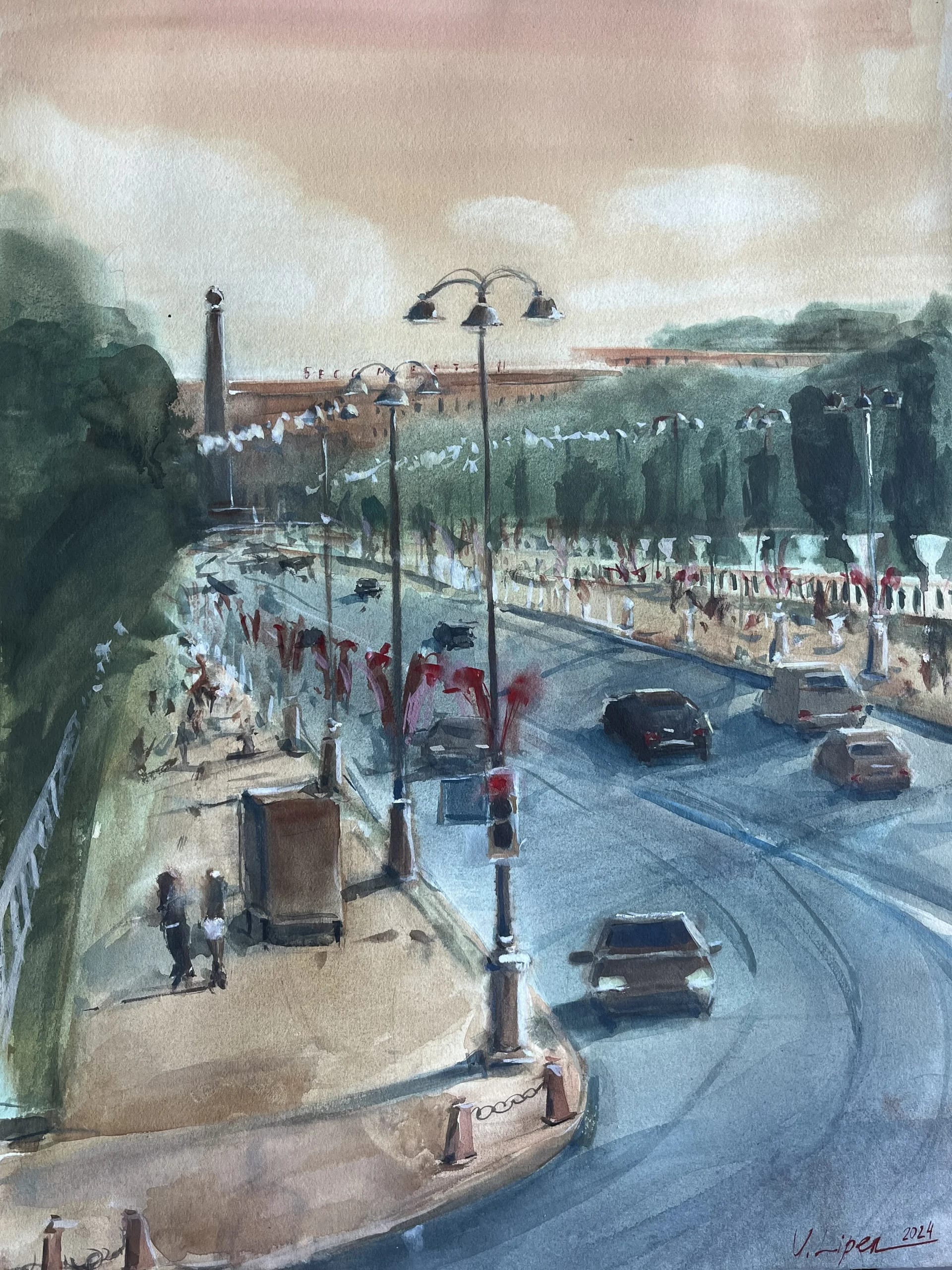
Minsk, Victory Square
Paper, watercolor · 43 × 56 cm
This work didn't come to me immediately. Three times I began composing this view — and three times I stopped, because I couldn't find what exactly was mine here. A wide avenue, cars, streetlights, trees — a city like thousands of others. Then I understood: mine was the rhythm.
I was looking from above, and the avenue unfolded before me like a musical score. The lamp posts beat out a vertical rhythm, the curve of the road sets an arc, red spots of flower beds — accents, like percussion in orchestral fabric. The tiny figures of people on the sidewalk to the left — smaller than can be distinguished — and at this scale the city ceases to be a sum of buildings and becomes movement. Warm evening light floods everything with a unified tone, and even the cars lose their utilitarian nature, transforming into dark drops gliding along the channel of the street.
It was important for me to preserve the panoramic scope without losing the warmth of handwork. The composition is built on a diagonal — from the lower left corner up and to the right, and this inclination creates the sensation that you're peering down, leaning slightly over a railing. The palette is deliberately muted, almost sepia, with touches of green and red — like old color photographs where the color has already begun to fade, but memory still holds.
Stop for a second and listen — this city has a voice.